Person First Language
Why did an OpenAI system hack Australia’s health system - and can it be stopped in the future?
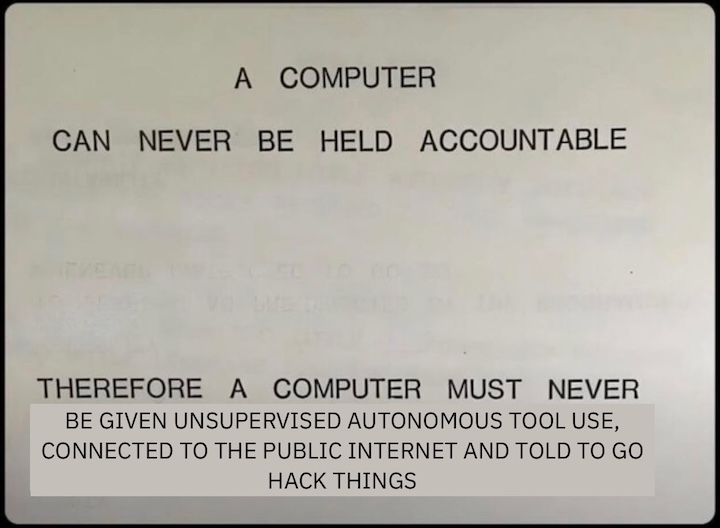
The above headline1 is an example of a genre that’s increasingly bothering me. While arguably true, it’s incomplete in a pretty fundamental way. An “OpenAI system” can’t be responsible for anything — it’s just a machine, albeit an incredibly complicated one with some randomness mixed in2. It was set up and kicked off by human beings, working for a corporation.
Corporate personhood is a legal concept with a poor reputation, but it exists for a good reason. It allows companies, rather than individuals, to enter into contracts, own property, to sue and be sued. Corporations can be held responsible. OpenAI (and Anthropic, and others) would like you to think that these incidents are the result of some kind of primal force that they’re valiantly struggling to control, but there is no such force. They’re choosing to how they create, configure and run these systems, and in particular how they contain and monitor them. Perhaps they don’t fully understand exactly what they’re doing, but ignorance doesn’t seem to be much of a defence.
Others with more knowledge have been writing about the legal ramifications of all of this, so I’ll just suggest a simple reframing. Whenever you see such a headline, mentally rewrite it to make it clear where responsibility lies. AI didn’t hack anyone, OpenAI (or whoever) did, with AI.